
My friend Hamza has a two-year-old Golden Retriever called Ziggy, the same Hamza I wrote about in my Orijen dog food review when he asked me whether $7.40 a pound was justified for a Golden’s food. Ziggy is everything you expect from a Golden: two enormous enthusiasms, a conviction that every person he meets is his best friend, and a complete inability to be in the same room as a ball without trying to retrieve it.
A few weeks ago Hamza called me about something different. Not Ziggy’s food this time, Ziggy’s timeline. He’d been reading about Golden Retriever lifespans and had come across the well-documented cancer statistics for this breed. He wasn’t panicking, but he was thoughtful about it. He asked me: ‘How long do Goldens actually live, and is there anything I should be doing with his food now, at two, that I’m not doing?‘
It’s a good question and a more layered one than it looks. I spent two weeks researching it properly: the lifespan data from multiple sources, the context around the cancer statistics (which needs careful handling to be useful rather than alarming), and how feeding at each life stage connects to the full Golden Retriever lifespan picture. This article is what I put together for Hamza.
Standard transparency note: I’m not a Golden owner. I have Churro, my French Bulldog, and I’ve researched Goldens extensively through Hamza, Ziggy, Biscoff, Layla, Sunny, and my aunt’s stories across multiple BreedAndBowl articles. I’m not a vet. This is a researcher and dog owner’s honest account of what the data says.
Raza’s standard disclaimer: Nothing here is veterinary advice. The lifespan figures are breed averages from published sources. The cancer statistics are documented breed research data included because Golden owners deserve to know them, not to create alarm about any individual dog. This guide is about feeding at each life stage, not about making predictions for any specific Golden. For any health concerns about your dog, your vet is the right call.
How Long Do Golden Retrievers Live? What the Data Actually Says
The figure that comes up consistently across all the sources I researched is 10 to 12 years, which is also what the AKC’s official Golden Retriever breed page cites as the expected lifespan. Multiple population studies in both North America and Europe arrive at the same range, which gives me more confidence in it than a single source would.
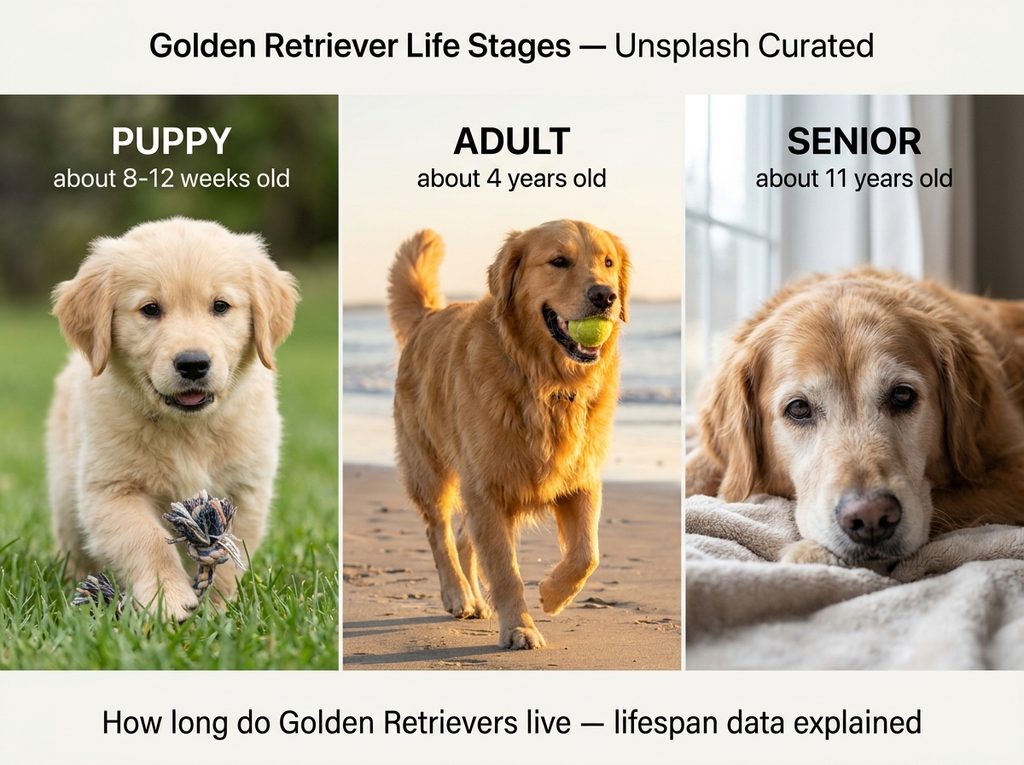
Ziggy at two is right at the beginning of his life on this timeline. If the average holds, Hamza has eight to ten years ahead of him, which sounds like a long time until you map it to a specific number of summers, and then it starts to feel more finite than it did.
The historical comparison — why Goldens live shorter now
Something I found genuinely interesting in my research: multiple sources I consulted note that Golden Retriever lifespans appear to have shortened over recent decades. Some research suggests Goldens in the 1970s had average lifespans of 16 to 17 years, considerably longer than the 10 to 12-year average today. The leading explanation is the breed’s elevated cancer rate, which I’ll cover in Section 3. This isn’t a settled, universally agreed-upon finding; historical comparison of veterinary data has methodological challenges, but it’s referenced consistently enough to be worth knowing about.
The upper range: what ‘with exceptional care’ actually means
Multiple sources I found reference Goldens reaching 13 to 15 years in well-managed circumstances, and the oldest documented Golden on record, a dog named Augie, reportedly reached 20 years and 11 months, which is genuinely extraordinary for any large breed. I want to be careful not to frame the upper range as achievable with the right food and habits; there’s a significant genetics component that no amount of good feeding can override. But the range between 10 and 15 years is real, and the factors that tend to push individual dogs toward the upper end are worth understanding.
| Breed | Average Lifespan | Size |
|---|---|---|
| French Bulldog | 10–12 years | Small/Medium |
| Labrador Retriever | 10–12 years | Large |
| Golden Retriever | 10–12 years | Large |
| German Shepherd | 9–13 years | Large |
Approximate averages from AKC breed standards and veterinary surveys. Individual variation is significant in all breeds.
The Cancer Context — What Golden Owners Need to Know Without Panic
I want to address this directly because Hamza had encountered it, and it’s the kind of information that can be either genuinely useful or genuinely anxiety-inducing depending on how it’s framed. I’m going to give it the most honest and measured framing I can.
Multiple sources I researched include the Morris Animal Foundation’s Golden Retriever Lifetime Study, the most comprehensive canine health research program of its kind, a document that Golden Retrievers have an elevated cancer rate compared to most other breeds. The figures cited across peer-reviewed sources and breed research place the proportion of Golden Retrievers affected by cancer in their lifetime in the range of approximately 60 percent. This is a well-documented, research-backed finding, not a fringe statistic.
I told Hamza this because I think Golden owners deserve to have accurate information rather than a vague ‘they’re prone to some health issues’ statement. But I also want to be clear about what this statistic means and doesn’t mean for Ziggy specifically.
What it means: Cancer is the leading documented cause of death in this breed, and it’s worth Golden owners having regular veterinary check-ups, knowing the breed’s health profile, and maintaining good overall care throughout the dog’s life. That’s good practice for any dog, and especially relevant here.
What it doesn’t mean: Ziggy has a 60% chance of dying from cancer in a way that’s a fixed outcome regardless of his circumstances. Breed-level statistics describe population trends, not individual predictions. Ziggy’s genetics, his specific background, his veterinary care, and a degree of chance all contribute to his individual picture. The statistic is worth knowing; it shouldn’t be the thing Hamza goes to bed worrying about every night.
What I told Hamza directly: The cancer statistics for this breed are real and worth knowing.
The most actionable thing they point toward is consistent veterinary care and not skipping
annual check-ups. Early detection genuinely matters for outcomes in the conditions this
breed is most prone to. Food quality supports overall health. It isn’t a replacement for
regular vet visits, and no food claim on BreedAndBowl is going to say it is.
The Five Life Stages of a Golden Retriever
Here’s how I’d map the Golden Retriever lifespan into distinct phases because ‘puppy, adult, senior’
doesn’t capture enough nuance for a breed with a 10 to 12-year average:
| Stage | Age range | What's happening | Food priority |
|---|---|---|---|
| Puppyhood | 0–12 months | Rapid growth, all developing | Large breed puppy formula |
| Adolescence | 12–18 months | Growth done, filling out | Transition to adult food |
| Prime adult | 2–6 years | Peak condition, food-motivated | Weight management + joint support |
| Middle age | 6–8 years | Activity moderating slightly | Same formula, monitor weight closely |
| Senior | 8+ years | Lower activity, slower metabolism | Senior formula considerations |
Age ranges are approximate. Individual Goldens vary significantly.
Ziggy at two is entering prime adult, the longest stage in the lifespan and the one where the food decisions Hamza makes daily are, cumulatively, the most relevant. Four years of prime adult ahead of him, each one requiring consistent weight management and appropriate nutrition. That’s what I tried to convey to Hamza: not that two is when to start worrying, but that two is a genuinely important nutritional chapter.
What to Feed at Every Stage — Raza’s Age-by-Age Breakdown
Here’s how feeding should look at each stage, connecting the lifespan timeline above to what actually goes in the bowl.
PUPPYHOOD — 0 to 12 months
Large breed PUPPY formula specifically, not a generic puppy food. According to AAFCO’s nutritional guidelines, large breed puppy formulas control calcium and phosphorus levels specifically for large breed bone development; this isn’t optional for a Golden puppy. Named meat protein as the first ingredient. DHA from fish oil for brain development. Three meals a day until six months, then two. Update portions every two to three weeks during peak growth.
ADOLESCENCE — 12 to 18 months
Transition to large breed ADULT food between 12 and 15 months gradually over 10 days, not abruptly. Named protein at 25%+ for muscle maintenance. Glucosamine and chondroitin begin to matter, either from named protein sources or added. Omega-3 from fish oil for the double coat that’s now fully developing. Grain-inclusive formula strongly preferred for this breed given the ongoing DCM research.
PRIME ADULT — 2 to 6 years
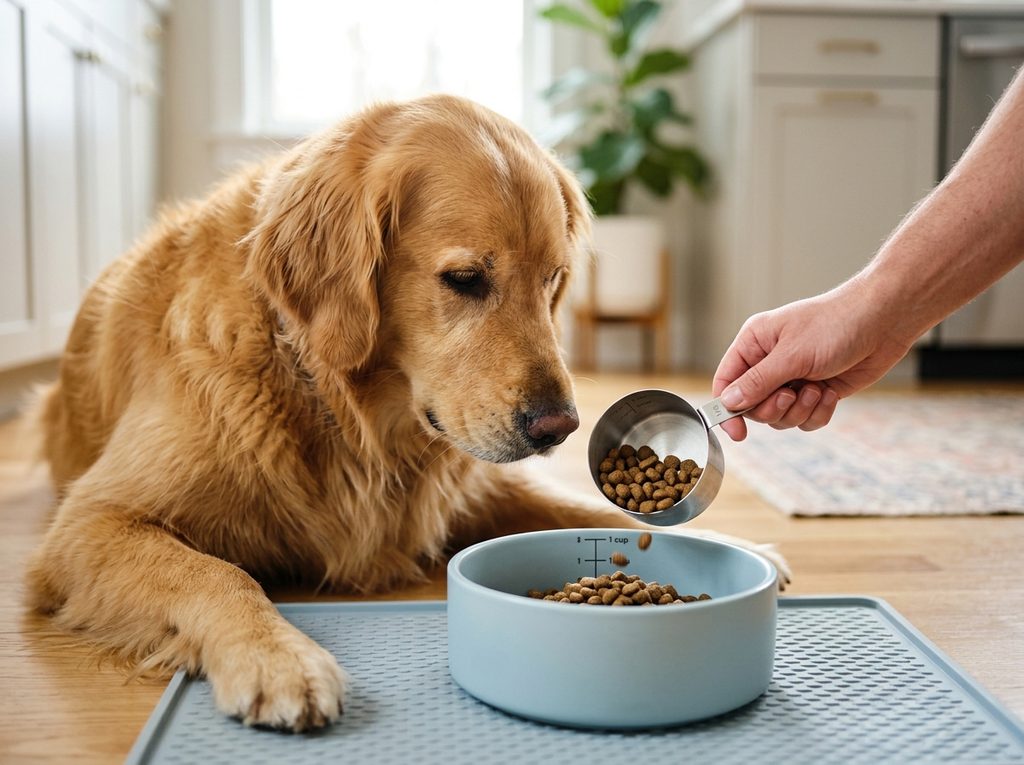
Quality large breed adult formula throughout. What I check for Ziggy’s situation specifically: grain-inclusive formula given the breed’s documented relationship with the DCM research; named protein at 25%+ for muscle maintenance; glucosamine and chondroitin in the guaranteed analysis for the sporting breed joint demands; EPA and DHA from fish oil for the double coat. Monthly weigh-ins. Kitchen scale for gram measurements. Treats counted in daily total. I covered Ziggy’s food in detail in my Orijen review Ziggy is currently on Orijen, which Hamza has had good results with for an active, twice-daily running dog.
MIDDLE AGE — 6 to 8 years
Stay on the adult formula but start monitoring weight every two to three weeks rather than monthly. If weight trends upward despite consistent activity, check whether the kcal/cup on the current food is still appropriate for the actual current activity level, which may have moderated from age two or three. Joint support nutrients matter more here, not less. Don’t downgrade formula quality just because the puppy phase is long past. This is also the stage where senior health screening often begins at annual vet visits: baseline bloodwork and cardiac checks, which is worth knowing as context for why food quality in this window still matters.
SENIOR — 8 years and older
Senior formula or a weight management formula with lower caloric density. What I specifically look for: continued glucosamine and chondroitin; these matter more in senior years as joints have accumulated more wear; maintained protein levels for muscle preservation rather than dramatic reduction; higher fiber for satiety on fewer calories; vitamin E and antioxidants. Two meals maintained. Monthly weight checks from age 8 without exception. If the current formula isn’t addressing a specific need, the senior years are when a vet conversation about food is most valuable. I covered senior Golden nutrition from a Frenchie-adjacent perspective in my senior food guide; the principles apply similarly across life stages.
Raza’s note: Ziggy has six years before this stage. Hamza and I have already had a
preliminary conversation about what it means. That’s exactly the right time
to start understanding it, not when it’s already arrived.
The Food Questions Golden Owners Ask Me Most
When should I switch my Golden from puppy to adult food?
Between 12 and 15 months. Earlier than a GSD (15 to 18 months), later than a small breed (12 months). The large breed puppy formula should stay in place until the growth phase is genuinely complete, not just until the dog looks adult-sized, which happens earlier than the body is done developing.
Is grain-free food okay for a Golden Retriever?
This is the question I get most specifically from Golden owners, and my consistent answer is: grain-inclusive formulas are preferable for this breed given how frequently it appears in the ongoing DCM research. The research remains inconclusive, but when a quality grain-inclusive option is available that meets all the other nutritional requirements, I lean that direction for Goldens specifically. I covered this in detail in my Golden sensitive stomach article and my GSD vs Golden comparison.
At what age is a Golden considered senior?
Most veterinary sources use 8 years as the Golden Retriever senior benchmark. Some actively engaged Goldens maintain a prime adult profile longer; some show senior characteristics earlier. 8 is the planning guide, not a hard rule. Your vet’s annual check-up is the best time to assess where your specific Golden sits.
Does what I feed Ziggy actually matter for how long he lives?
This was the exact question Hamza asked, and I want to give him the honest answer here too. Food quality and appropriate nutrition at each life stage is one meaningful variable among several. It isn’t the most powerful variable; genetics and veterinary care likely matter more. But it’s one of the most directly actionable ones an owner has control over, which makes it worth doing well regardless of how it ranks in the hierarchy of what determines a Golden’s lifespan.
My Honest Final Take
I called Hamza after finishing this research. I told him the honest version: 10 to 12 years is the range most sources converge on; the cancer statistics are real and worth knowing about in a way that makes regular vet care more rather than less important, and Ziggy at two is in his prime with everything still ahead of him. Hamza said: ‘So I’ve got ten more good years of having a dog who thinks every walk is the best walk that has ever happened.’ Which is the right way to hold it.
The food connection for Goldens is real weight management especially, given how food-motivated this breed is and how directly body condition connects to how a large dog’s body holds up across its lifespan. The grain-free question is specific to this breed and worth being thoughtful about. And the life stage framework matters: the same formula that’s right for Ziggy at two won’t be right for Ziggy at nine, and knowing that in advance is more useful than discovering it by default.
Ziggy is currently bounding around Hamza’s flat and pretending that every object he encounters is a potential retrieve target. He’s two. He’s exactly what a two-year-old Golden Retriever should be. The rest of the questions in this article are for later, and Hamza is now better prepared for.