
I’ve now written lifespan guides for three of the four breeds BreedAndBowl covers German Shepherds, Labrador Retrievers, and Golden Retrievers. In each one, the question came from someone else: Imran asking about Storm, Priya asking about Coco, Hamza asking about Ziggy. I researched each one because a friend or reader wanted to know.
This one I researched because of Churro. Nobody asked me. I just found myself doing the maths one evening Churro is three, the AKC says 10 to 12 years for this breed, which means I’m roughly a quarter to a third of the way through his life, and I realised I had never actually looked into what his lifespan picture looks like with the same rigour I’d applied to the other three breeds. That’s a strange thing to admit for someone who runs a dog food blog and has written more about Churro than about any other dog. But the lifespan question felt more personal for this one, which I think is why I’d been putting it off. I wrote the other three guides from a comfortable research distance. This one I wrote about my own dog.
What I found is worth sharing both the actual lifespan data and the specific Frenchie factors that make this breed’s lifespan picture different from the other three I’ve covered. And, as always on BreedAndBowl, how what goes in the bowl connects to each stage of that picture.
Raza’s standard disclaimer: Nothing here is veterinary advice. Lifespan figures are
breed averages from published sources individual Frenchies vary significantly based on
genetics, health, and care. The brachycephalic factors I cover in Section 3 are structural
realities about this breed, not predictions about any individual dog. For specific concerns
about your Frenchie’s breathing, weight, or health at any stage, your vet is the right call.
How Long Do French Bulldogs Live? What the Data Actually Says
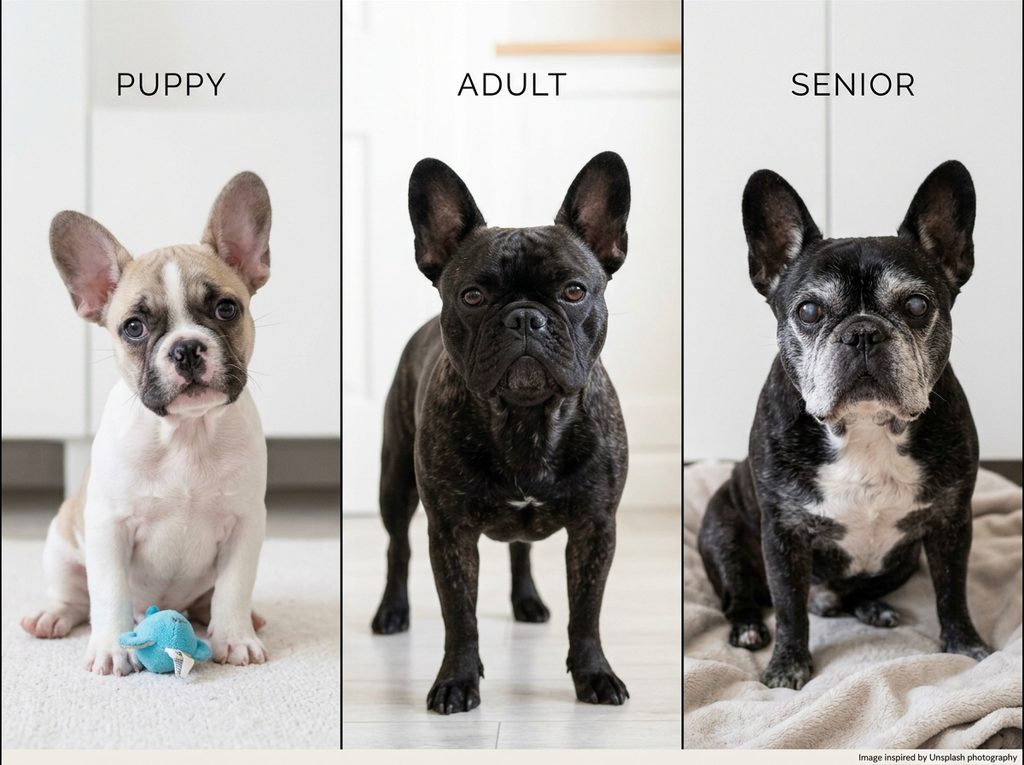
The figure that comes up consistently across every source I checked is 10 to 12 years, which is also what the AKC’s official French Bulldog breed page cites. This is a narrower range than some of the other breeds I’ve covered Goldens sit at 10 to 12, Labs at 10 to 12, and GSDs at 9 to 13, but within that range there’s genuine variation driven by factors I’ll get into in Section 4.
Why Frenchies don’t live as long as other small breeds
This is something I found genuinely interesting when I started researching. French Bulldogs are classified as a small-to-medium breed, and small dogs typically live longer than large breeds. Chihuahuas reach 14 to 16 years, and Boston Terriers 11 to 13. But Frenchies sit at 10 to 12 despite their smaller size. The reason is the brachycephalic anatomy the flat face that defines the breed also creates structural challenges that compress the upper range of what Frenchies typically achieve, in a way that a small breed without these structural factors doesn’t experience. Churro’s size is working for him; his face structure is a separate variable working against the typical small-breed advantage.
The alarmingly low number that sometimes circulates online
I want to address this because Frenchie owners sometimes encounter a frightening figure some population-level veterinary studies produce life expectancy numbers considerably lower than 10 years
for this breed. The context matters enormously: those figures include neonatal deaths, dogs from irresponsible breeding programs with severe structural issues, dogs surrendered to shelters without full veterinary care, and dogs who never received appropriate ongoing care. They are not the lifespan of a well-cared-for Frenchie from a responsible breeder with regular veterinary attention. For Churro, from a responsible breeder and in a home with consistent care, the 10 to 12-year AKC range is the right anchor for planning purposes.
The Brachycephalic Factor — What the Flat Face Means for the Lifespan Picture
This is the section of this article that has no equivalent in the GSD, Lab, or Golden lifespan guides because those breeds don’t have a structural anatomical factor that directly intersects with how long they live. Frenchies do.
Brachycephalic Obstructive Airway Syndrome BOAS is the umbrella term for the breathing difficulties that stem from the French Bulldog’s flat face: narrow nostrils, an elongated soft palate, and sometimes a too-narrow windpipe. In mild cases, BOAS is a manageable condition with careful monitoring and appropriate exercise and temperature limits. In severe cases, research published in The Veterinary Journal in April 2026 found that severe, untreated BOAS can be associated with a meaningfully reduced lifespan compared to well-managed Frenchies.
I want to be careful here about how I frame this, because I think it’s the section most likely to cause unnecessary alarm if I’m not precise. Churro has mild BOAS, the characteristic snoring and occasional snuffling that most Frenchies have. He’s been assessed by his vet, and his breathing is considered appropriate for the breed without requiring surgical intervention. Mild BOAS is not the same as severe BOAS, and the research finding I mentioned above specifically applies to the severe end of the spectrum, not to every Frenchie who snores on the sofa.
What this means for feeding the direct food connection is that excess weight makes BOAS worse in Frenchies specifically, not just in the general ‘excess weight is bad for all dogs’ way. The extra fat around the neck and chest of an overweight Frenchie adds pressure to an airway that’s already structurally narrow. This is why weight management in a Frenchie isn’t just about joint health or general condition it’s about protecting the airway function that’s already under structural pressure. I’ve covered this in my flagship Frenchie food guide, but it belongs in this lifespan article too.
The direct food connection for BOAS: Keeping a Frenchie at appropriate body weight is
one of the most directly food-related things an owner can do that has a structural benefit for
this breed’s breathing. Not because food prevents BOAS it’s structural, not dietary, but
because excess weight compounds a structural condition that already exists. For Churro,
this means his weight management has a higher priority than it would for a non-brachycephalic breed.
What Drives the Variation in Frenchie Lifespan
Within the 10 to 12 year range, here’s what research consistently points to as the main variables, with the Frenchie-specific context for each:
Genetics and breeding background
This matters more for Frenchies than for almost any other breed I’ve covered, because the structural traits that affect this breed’s health the degree of BOAS, spinal structure, and eye prominence are directly inherited. Frenchies from health-focused breeders who select for better airway function, moderate facial structure, and known healthy spinal geometry tend to sit toward the upper end of the lifespan range. The colour of the coat is also worth knowing about certain rare or heavily selected colours like blue, lilac, or merle have been linked to additional genetic health risks beyond the standard Frenchie profile.
Weight management — more critical here than in other breeds
I’ve already covered the BOAS connection above. The practical point is that two to three extra pounds
on a Frenchie has a more direct structural consequence than two to three extra pounds on a Lab. The
scale matters across all breeds; for Frenchies, it carries an additional reason to take it seriously.
Heat management
Frenchies cannot cool themselves as efficiently as other breeds because their compressed airways limit the panting mechanism. Overheating and heatstroke are well-documented risks for this breed. While this is primarily an exercise and environment management point rather than a food one, it intersects with feeding keeping a Frenchie lean reduces the metabolic heat load and makes hot conditions more manageable.
Consistent veterinary care
For Frenchies specifically, regular check-ups allow vets to monitor BOAS progression, watch for early signs of spinal issues (IVDD is more common in this breed due to their compact build), and assess whether any intervention is warranted before a condition progresses. I take Churro for regular check-ups, and his vet specifically monitors his airway at each visit, which is appropriate for this breed and not something I’d skip.
The Five Life Stages of a French Bulldog
| Stage | Age range | Food priority |
|---|---|---|
| Puppyhood | 0–12 months | Puppy formula for small/medium breeds |
| Adolescence | 12 months | Move to adult food |
| Prime adult | 1–8 years | Quality adult formula + portions |
| Middle age | 7–8 years | Monitor weight, same formula |
| Senior | 8–10+ years | Senior formula considerations |
Churro is at the start of his prime adult stage. At 10 to 12 years total, prime adult is the longest chapter
of a Frenchie’s life and the one where weight management discipline, consistent food quality, and
the ongoing structural considerations all matter most consistently. I’ve covered this stage in detail in the
flagship guide. What the lifespan framing adds is the ‘this is most of his life’ context that makes getting
it right feel more meaningful than it might seem at three years old.
What to Feed at Every Stage — From Churro’s Own Life
This is the section where the lifespan data above connects to what actually goes in Churro’s bowl at
each stage. Unlike the other three lifespan guides, I’m writing this one from direct experience at the
stages Churro has already been through.
PUPPYHOOD — 0 to 12 months
Small or medium breed PUPPY formula, not large breed. According to AAFCO’s nutritional guidelines, puppy formulas for small and medium breeds are calibrated differently from large breed formulas, with higher caloric density per cup for a smaller stomach and appropriate mineral ratios for smaller bone development. Named meat protein first. DHA from fish oil for brain development. Three meals a day until six months, then two. Portions updated every few weeks during peak growth.
ADOLESCENCE — 12 months
Transition to adult food at 12 months gradually over ten days. For Frenchies specifically: wave-shaped or curved kibble for the flat face. Moderate protein and fat appropriate for a low-to-moderate activity breed.
Start building the weight management habit from the beginning of adulthood, not after weight gain has already happened. The slow feeder bowl should already be in place from puppyhood.
PRIME ADULT — 1 to 7–8 years
What I do for Churro specifically: Royal Canin French Bulldog Adult (reviewed in depth in my Royal Canin Frenchie review). Kitchen scale for gram measurements, not cups. Two meals a day, measured. Treats
counted into the daily calorie total. Monthly weigh-ins. No table scraps. The slow feeder bowl in use at every meal. Annual vet check-ups with BOAS monitoring specifically noted. This isn’t complicated it’s consistent.
MIDDLE AGE — 7 to 8 years
Same adult formula, closer monitoring. Weight checks every two to three weeks rather than monthly. If activity has decreased, reduce portions before weight drifts upward don’t wait for weight gain to be established and then react. This is also the stage to start thinking about the senior formula transition I covered in my Frenchie senior food guide.
SENIOR — 8 to 10+ years
I’ve covered this in detail in my senior French Bulldog food guide. The short version: lower calorie density to match reduced activity; maintain protein quality for muscle preservation; glucosamine and chondroitin for joint support; continue slow feeder and measured portions. The same ingredient quality standards from adulthood don’t relax in senior years, three smaller meals rather than two if digestion seems to benefit from smaller volumes.
The Food Questions Frenchie Owners Ask Me Most
Based on BreedAndBowl messages and conversations with Frenchie owners, here are the questions that come up most around feeding and lifespan:
Does what I feed my Frenchie actually affect how long they live?
The honest answer: food quality and appropriate portions are one meaningful variable among several. For Frenchies specifically, weight management has a structural importance that makes it slightly more directly relevant than in non-brachycephalic breeds keeping a Frenchie lean protects an airway that’s already under structural pressure. That’s a real connection, not a vague ‘good food is good’ statement. But genetics and veterinary care likely matter as much or more than food alone.
When should I switch my Frenchie from puppy to adult food?
At 12 months for most Frenchies. This is earlier than large breeds. The small/medium breed puppy formula isn’t needed beyond this point, and the adult formula’s calibration is more appropriate from here. Transition gradually over ten days.
At what age is a French Bulldog considered senior?
Most veterinary guidance uses 8 years as the starting point for senior considerations in Frenchies, though some individual dogs show senior characteristics earlier depending on their genetics and health history. I’d start paying closer attention from around 7 to 8 years rather than waiting until something obviously changes.
Is grain-free food okay for a Frenchie?
Unlike Goldens, where the breed appears more frequently in the DCM research, the grain-free concern doesn’t carry quite the same breed-specific weight for Frenchies. The general caution around grain-free diets applies, but it’s not as specifically documented for this breed as it is for Golden Retrievers. Churro eats a grain-inclusive formula (Royal Canin Frenchie Adult), and I’d continue with that approach, but the choice isn’t as strongly weighted for this breed as it is for Goldens.
My Honest Final Take
Churro is three years old. The AKC says 10 to 12 years. That means I’m somewhere between a quarter and a third of the way through his life, which feels both reassuring and surprisingly finite at the same time. Seven to nine more years is a lot and also, from this vantage point, not unlimited.
What I took from researching this is that the Frenchie lifespan picture has a specific character that the other three breeds I’ve covered don’t share. The flat face that makes Churro Churro the snoring, the snuffling, the particular way he breathes when he’s excited is also a structural variable that makes
weight management matter in a more direct way than it does for a Golden or a Lab. The food discipline I’ve built around Churro isn’t just about keeping him in shape. It’s about protecting an airway that has less margin than most breeds.
Churro is currently asleep on the sofa, as he often is at this hour. His weight is 26 lbs, which is appropriate. His coat is good. His breathing is what his vet calls normal for the breed. He has, if the data is right and if we’re both lucky, somewhere between seven and nine more years of this.